Bar Stock vs. Plate Stock: How to Select the Right Raw Material for Manufacturing?
I What is Bar Stock?
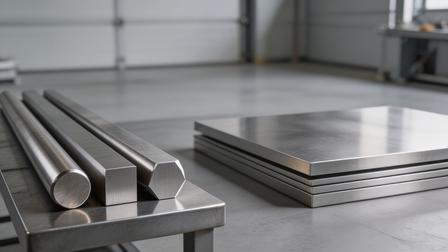
Bar stock refers to standardized, long-length raw material manufactured with a consistent cross-sectional profile along its entire length. It serves as the primary feedstock for subtractive manufacturing processes, where operators shape finished components by cutting, drilling, turning, or milling away excess material. Produced with uniform chemical composition and internal grain structure, bar stock delivers predictable machinability and consistent mechanical performance across every section of the material. It is available in a range of standard lengths and cross-section shapes to match different production needs.
II Common Bar Stock Forms & Their Industrial Uses
Bar stock is produced in multiple cross-sectional geometries, each optimized for specific manufacturing operations and component functions.
Round bar stock, with its symmetrical cylindrical profile, is the standard feedstock for lathe turning operations. Its uniform diameter allows for continuous, high-precision machining of rotational parts such as shafts, pins, rollers, and fastener blanks.
Square bar stock features four equal straight sides, and is widely used for fabricating structural frames, mounting brackets, and support components. Its flat, stable surfaces simplify fixturing during machining and welding, making it a staple for general engineering structures.
Flat bar stock has a rectangular cross-section with a wide, thin profile, and is ideal for producing gaskets, sealing elements, base plates, and structural braces that require a broad load-bearing surface with moderate thickness.
Hexagonal bar stock is defined by its six-sided cross-section, and serves as the primary raw material for manufacturing threaded fasteners including bolts, nuts, and set screws. Its flat sides provide secure grip for tooling during threading and installation.
III Key Material Types of Bar Stock
Bar stock is available in a wide range of material formulations, each engineered for specific performance requirements and industrial environments.
Carbon Steel Bar Stock
Carbon steel bar is valued for its high tensile strength, excellent machinability, and strong weldability across a wide range of industrial applications. Available in multiple carbon grades, it can be heat-treated to achieve targeted hardness and toughness levels, making it suitable for forged components, heavy-duty structural parts, and power transmission elements. The automotive industry relies heavily on carbon steel bar for producing crankshafts, axles, and connecting rods that must withstand sustained mechanical loads without deformation.
Stainless Steel Bar Stock
Stainless steel bar offers exceptional corrosion resistance and high-temperature stability, thanks to its chromium alloy content. It maintains hygienic, non-reactive surfaces even when exposed to moisture, chemicals, or bodily fluids, making it the material of choice for food processing equipment, pharmaceutical machinery, and surgical instruments. It also delivers reliable tensile strength and long-term durability for outdoor and marine engineering components.
Aluminum Bar Stock
Aluminum bar stands out for its exceptional strength-to-weight ratio, natural corrosion resistance, and high thermal and electrical conductivity. It is significantly lighter than steel while retaining sufficient structural rigidity, making it a preferred option for weight-sensitive applications. The automotive and transportation sectors use aluminum bar for window frames, suspension components, and heat exchanger parts, while aerospace engineers rely on high-strength aluminum alloy bars for structural aircraft elements.
Plastic Bar Stock
Engineering plastic bar provides a lightweight, corrosion-resistant alternative to metal materials, with a broad range of performance profiles depending on the polymer formulation. Many plastic grades offer low friction coefficients, self-lubricating properties, and excellent chemical inertness. These characteristics make plastic bar suitable for manufacturing gears, bushings, wear pads, and fluid handling components in food processing, medical, and chemical processing facilities where contamination resistance is critical.
IV What is Plate Stock?
Plate stock is a flat, rectangular form of raw metal or alloy material produced with a consistent thickness across a large surface area. It is one of the most widely used raw material formats in heavy industry, serving as the base material for sheet metal fabrication, structural construction, heavy machinery manufacturing, and custom CNC machined components. Plate material is classified separately from thinner sheet stock based on its thickness, and is available in standard sheet dimensions to suit large-scale fabrication projects.
V Core Manufacturing Processes for Metal Plates
The production of metal plate involves a sequential set of industrial processes that refine raw metal into flat, dimensionally consistent sheets with targeted material properties.
Casting Process
The production cycle begins with casting, where molten metal is poured into large rectangular molds and allowed to solidify into ingots or continuous cast slabs. These cast slabs serve as the starting blank for subsequent rolling and forming operations.
Deformation Process
The cast slab undergoes a series of hot and cold rolling operations, where it is passed through pairs of heavy rollers to reduce its thickness and elongate its surface area. Additional forming processes such as forging and extrusion may be applied for specialty plate grades to refine grain structure and improve mechanical strength.
Material Removal Process
After initial forming, excess material and surface imperfections are removed through trimming, edge milling, or precision cutting processes. Advanced methods such as laser cutting and waterjet cutting are also used at this stage to cut standard plate blanks into custom sizes for customer orders.
Heat Treatment Process
To adjust internal material properties, plates undergo controlled heat treatment processes including annealing, quenching, tempering, and aging. These procedures modify hardness, ductility, machinability, and fatigue resistance to match specific application requirements.
Joining and Assembly Process
For large-scale structural applications, multiple plate sections may be permanently joined via welding, brazing, or mechanical fastening to create larger composite panels or structural assemblies.
Finishing Process
The final production step applies surface treatments to improve performance and appearance. Common finishing operations for plate stock include polishing, galvanizing, painting, oiling, and burnishing. These treatments enhance corrosion resistance, improve surface smoothness, and provide protection during storage and transportation.
VI Popular Types of Metal Plate Stock
Metal plate is produced in a variety of material grades and surface treatments, each engineered for specific operating environments and functional needs.
Galvanized Plates
Galvanized plate features a protective zinc coating applied to the base steel surface, which dramatically improves resistance to rust and atmospheric corrosion. It maintains stable performance across a wide temperature range and is widely used for roofing panels, wall cladding, storage sheds, and automotive body components that require long outdoor service life.
Checkered Plates
Checkered plate is defined by its raised, repeating geometric patterns on the top surface, which create a non-slip texture. The raised patterns increase surface friction, making this plate type ideal for walkways, factory floors, stair treads, and truck bed linings. Its textured surface also hides minor scratches and dirt accumulation, reducing maintenance requirements.
Mild Steel Plates
Mild steel plate is a low-carbon steel variant available in a broad range of standard thicknesses. It offers excellent weldability, good formability, and compatibility with standard metal cutting tools, making it the most widely used plate material in the construction and heavy equipment industries. It is commonly used for building structural frames, equipment bases, and general fabrication work.
B.I. and G.I. Plates
Black Iron (B.I.) and Galvanized Iron (G.I.) plates are two staple materials in the construction and HVAC sectors. Both receive zinc-based coating for corrosion protection, but differ in base alloy composition: B.I. plates incorporate aluminum and copper alloy elements, while G.I. plates use a pure iron base with full zinc galvanization. G.I. plates are commonly used for household appliances and sanitary piping, while B.I. plates are preferred for air conditioning units and outdoor billboard structures.
VII Key Differences Between Bar and Plate Stock
While both bar and plate stock are fundamental raw materials in manufacturing, they differ significantly in form, production method, and ideal use cases.
Applications
Bar stock is designed for producing discrete, three-dimensional components with defined cross-sections, such as shafts, pistons, fasteners, and precision mechanical parts used in automotive and aerospace systems. Plate stock, by contrast, is optimized for large-format flat structures, including bridge decks, ship hulls, building frames, and enclosure panels that require broad, continuous surface areas.
Manufacturing Process
Bar stock is typically produced through extrusion, cold drawing, and hot rolling processes, which shape the material by forcing it through a shaped die under heat and pressure. Plate stock is manufactured primarily through continuous hot and cold rolling of large cast slabs, with additional forging steps for thick, high-strength plate grades.
Shape and Dimensions
Plate stock is a flat, two-dimensional product defined by its length, width, and thickness, and is supplied in standard sheet sizes such as 4×8 feet or 5×10 feet. Bar stock is produced in long, continuous lengths (commonly 10 or 20 feet) with a fixed, uniform cross-sectional shape — round, square, rectangular, or hexagonal — along its entire length.
Material Features
The rolling production process for plate creates a grain structure that is elongated along the rolling direction, with slightly less uniformity through the material thickness, while still delivering good overall corrosion resistance. Bar stock, formed through extrusion or drawing, develops a more uniform, concentric grain structure across its cross-section, which enhances its radial strength and fatigue resistance for rotational and load-bearing applications.
VIII How to Select Between Aluminum Bar and Plate for CNC Machining?
When planning CNC machining projects with aluminum materials, choosing between bar stock and plate stock directly impacts machining efficiency, material cost, and final part quality. Consider the following key factors during material selection:
Size Range of the Finished Part
The overall dimensions and geometry of your finished part are the primary deciding factors. Bar stock has a narrow aspect ratio, with its width and thickness dimensions being relatively close, making it ideal for compact, prismatic, or rotational parts. Extruded aluminum square bars — particularly 6061-T6 grade — are among the most widely used feedstocks for aluminum CNC machining, delivering reliable tensile strength for structural components such as equipment frames, aerospace brackets, and vehicle chassis parts.
Plate stock features a wide, flat form factor with a high aspect ratio between its surface area and thickness. It is the better choice for large, flat components, enclosure panels, and parts that require broad continuous surfaces. Produced via continuous casting, aluminum plate is available in a wide range of thicknesses and can supply large, single-piece blanks for oversized parts that cannot be sourced from standard bar sizes.
Pricing and Material Efficiency
Pricing for both bar and plate aluminum is typically calculated by weight. On a per-pound basis, standard bar stock is generally more cost-effective than plate stock for equivalent alloy grades.
However, for parts with flat, wide geometries such as flanges, mounting plates, and ring-shaped components, sourcing pre-cut plate blanks can reduce total machining time significantly compared to milling the entire shape from a solid bar billet. For parts that are too wide or too thin to be efficiently machined from standard bar dimensions, plate stock delivers lower overall production costs despite its higher per-unit material price.
Condition of the Edge
Bar stock is typically cut to length with a band saw, leaving square cut ends. The extrusion process also leaves a small natural radius on the corners of square and rectangular bars, with a linear grain pattern running parallel to the bar length.
Plate stock can be cut to custom outline shapes using band saw, laser, or waterjet equipment, producing clean vertical edges with controllable dimensional accuracy. When selecting material, it is important to evaluate the stock tolerance of both natural as-produced edges and custom cut edges to ensure they align with your part’s final dimensional requirements.
IX Industry-Wide Applications of Bar and Plate Stock
Thanks to their versatility, structural reliability, and broad material compatibility, bar and plate stock are utilized across nearly every sector of modern manufacturing.
Aerospace
The aerospace industry relies on high-strength aluminum and titanium bar stock for manufacturing precision aircraft components such as landing gear pins, structural fasteners, and engine shaft parts. Aluminum alloy plates are used for fabricating wing skin panels, fuselage sections, and bulkhead structures that require large, continuous surfaces with high strength-to-weight performance.
Construction
In the construction sector, steel bar stock is embedded in concrete structures to improve tensile strength and structural durability. Solid steel bars also reinforce beams, columns, and support frameworks to resist external loads and seismic forces. Steel plate is used for structural base plates, bridge decking, building facades, and heavy-duty support brackets.
Automotive
Both bar and plate stock are essential to automotive production. Steel and aluminum bar is machined into engine mounts, suspension components, drive shafts, and chassis brackets that provide structural rigidity and load support. Plate stock is formed and stamped into body panels, frame rails, and undercarriage shields that make up the vehicle’s main structural shell.
Engineering and Manufacturing
Bar stock serves as the universal starting material for precision CNC machining, supporting the production of complex, tight-tolerance mechanical components via turning, milling, and drilling operations. Plate stock is the primary feedstock for sheet metal fabrication, heavy equipment manufacturing, and industrial machinery construction, where its large flat surface area enables efficient cutting and forming of structural and enclosure parts.
X Custom Machining Capabilities for Complex Geometries
As a full-service rapid prototyping and precision manufacturing provider, we deliver custom machined components in both bar and plate stock materials, with the capability to produce parts with highly complex geometries to match exact project specifications. Our advanced CNC machining equipment supports high-precision processing of a full range of metals and engineering plastics, with tight dimensional control for even the most intricate part designs.
Whether your project requires simple round shafts, square structural brackets, flat panel components, or highly complex multi-axis machined parts, our engineering team tailors the production workflow to your precise dimensional and performance requirements. We maintain fast turnaround times, consistent quality standards, and flexible production capacity to accommodate both small-batch prototype runs and high-volume production orders. Reach out to our team to discuss your project and receive a customized manufacturing solution.
XI Conclusion
Bar stock and plate stock are two indispensable raw material formats that form the backbone of modern industrial manufacturing. Each offers unique geometric and mechanical advantages that make them suited for distinct production workflows and end-use applications. Developing a thorough understanding of their material properties, manufacturing processes, and ideal use cases empowers engineering and production teams to select the optimal material for every project, reducing costs, minimizing waste, and improving final part performance.
XII Frequently Asked Questions
Can bar stock be customized for specific dimensions?
Yes, bar stock can be customized to specific lengths, cross-section sizes, and material properties through secondary processing operations including precision saw cutting, centerless grinding, heat treatment, and custom extrusion. Custom sized bar stock is available for both small-batch and large-scale production orders.
What is the difference between an aluminum plate and a flat bar?
The distinction is primarily based on width per standard industry convention. Flat rectangular aluminum material under 8 inches in width is classified as flat bar, while material 8 inches wide or wider is categorized as plate. Both share similar base material properties, but their different form factors make them suited for different part sizes and machining workflows.
What are the differences between sheets, plates, and bar stock?
Sheet metal is the thinnest format, ranging from approximately 1mm up to around 25mm in thickness, and is typically produced from large continuous coils. Plate is thicker than sheet, produced as individual flat panels via slab rolling, and is intended for structural and heavy-duty use. Bar stock is long-length material with a fixed, uniform cross-sectional shape, designed for use as feedstock for machining discrete three-dimensional components.