CNC Machining HDPE: Material Properties, Processing Guide, Troubleshooting & Industrial Applications
1. Overview of HDPE: Grades, Core Properties & Matching Use Cases
HDPE is a linear thermoplastic polymer with a density range of 0.93–0.97 g/cm³. Its ordered molecular chains deliver balanced rigidity, high impact resistance, easy machinability and weldability. The material absorbs almost no moisture, making it suitable for wet and corrosive working environments. There are six mainstream modified HDPE variants with distinct characteristics and applicable scenarios:
| HDPE Grade | Key Performance Features | Typical Applications |
|---|---|---|
| Standard General HDPE | Cost-efficient, easy to machine, acid & alkali resistant, balanced impact resistance | Industrial support blocks, basic food cutting boards, general plastic housings |
| UV-Stabilized HDPE | Formulated with UV additives to prevent cracking and degradation under long-term outdoor exposure | Outdoor agricultural machinery parts, construction panels, exposed marine components |
| Cross-Linked HDPE (PEX) | Cross-linked molecular chains for improved heat resistance, anti-crack performance and chemical inertness | Plumbing pipes, floor heating substrates, industrial corrosion-resistant pipelines |
| High-Molecular-Weight HDPE (HMW-HDPE) | Extended molecular chains greatly boost abrasion resistance and impact toughness | Automotive fuel tanks, marine fenders, equipment wear liners |
| Ultra-High-Molecular-Weight HDPE (UHMWPE) | Extreme wear resistance, ultra-low friction coefficient, superior load-bearing capacity | Bearings, plastic gears, wear-resistant fixture inserts |
| Fiber-Reinforced HDPE | Carbon/glass fiber filler enhances structural stiffness and tensile strength | Heavy-duty structural plastic parts, mechanical load-bearing components |
2. Core Advantages of HDPE Material
HDPE dominates multiple manufacturing sectors thanks to its comprehensive functional strengths:
2.1 Excellent Strength-to-Weight Ratio
HDPE combines lightweight construction with reliable structural durability, ideal for lightweight parts in automotive and aerospace industries.
2.2 Superior Machinability
It supports precise cutting, drilling and profiling via CNC equipment. Low tool abrasion reduces production costs, suitable for both prototype development and medium-volume mass production.
2.3 Universal Chemical Resistance
It stays intact when exposed to most acids, alkalis and industrial solvents, making it a top choice for chemical and marine equipment components.
2.4 Outstanding Impact Resistance
HDPE absorbs shock energy without cracking or fracturing, perfect for construction and agricultural parts under frequent physical stress.
2.5 Near-Zero Water Absorption
No swelling or dimensional degradation after long-term contact with water, widely adopted for piping and underwater marine parts.
2.6 Fully Recyclable
As a recyclable thermoplastic, HDPE cuts manufacturing waste and meets sustainable production standards.
3. Common CNC Machining Methods for HDPE
Multiple CNC technologies are applied to process HDPE, each with unique strengths for different part geometries:
3.1 CNC Milling
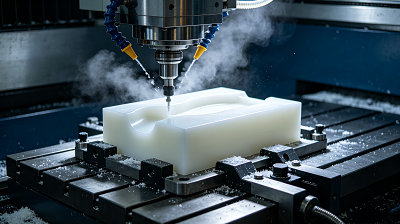
The most popular HDPE machining process. Rotating cutting tools remove excess material to form intricate 3D shapes. Best for low-to-medium batches with complex structures, delivering tight dimensional tolerances and premium surface finishes.
3.2 CNC Turning
Rotates HDPE blanks against fixed cutting tools, specialized for cylindrical parts including rollers, bushings and pipe fittings. It achieves fast production speed but lacks flexibility for complicated non-round geometries.
3.3 CNC Routing
Optimized for large flat HDPE sheets. Quickly cuts 2D outlines with high production efficiency, widely used for flat panel manufacturing. Tolerance and surface smoothness are moderate compared to milling.
3.4 CNC Drilling
Used alongside other CNC processes to create precise positioning holes and internal channels. It offers stable chip removal for simple hole features, with medium dimensional accuracy.
Comparison of Four HDPE CNC Machining Techniques
| Evaluation Item | CNC Milling | CNC Turning | CNC Routing | CNC Drilling |
|---|---|---|---|---|
| Tolerance Accuracy | High | High | Low to Medium | Medium |
| Surface Finish | Premium | Medium-High | Medium | Low-Medium |
| Tool Wear Level | Medium-High | Medium | Low | Low |
| Production Efficiency | Low-Medium | Fast | Very Fast | Medium |
| Dimensional Stability | Excellent | Excellent | Medium | Medium |
4. CNC Machining HDPE vs Other HDPE Manufacturing Processes
When producing HDPE components, CNC machining has distinct pros and cons compared to injection molding, extrusion and FDM 3D printing:
4.1 Precision & Tolerance Control
CNC machining delivers tighter dimensional tolerances than blow molding and extrusion. While injection molding achieves smooth surfaces for mass production, it requires expensive custom molds. FDM 3D printing has inconsistent dimensional consistency and lower resolution for industrial-grade HDPE parts.
4.2 Surface Quality
CNC machined HDPE maintains natural low-friction surface properties without secondary polishing, outperforming extrusion and 3D printing which produce rough as-manufactured surfaces.
4.3 Production Batch Adaptability
Injection molding and extrusion dominate high-volume mass production with ultra-fast cycle times. CNC machining eliminates mold costs and long setup cycles, making it the most economical option for prototypes and small-batch orders.
4.4 Dimensional Stability
CNC’s precise cutting logic minimizes thermal deformation even with heat generated during machining. Extruded HDPE retains stable linear dimensions, while injection molded and 3D printed parts may warp unevenly.
Cross-Process Performance Comparison Table
| Metrics | CNC Machining | Injection Molding | Extrusion | FDM 3D Printing |
|---|---|---|---|---|
| Tolerance Control | Ultra-Tight | Acceptable | Stable for linear profiles | Moderate |
| Raw Surface Finish | Excellent | Smooth | Rough | Coarse |
| Tool Consumption | Moderate-High | Minimal | Minimal | Negligible |
| Suitable Batch Size | Prototypes, Low/Medium Volume | Mass High Volume | Continuous Mass Production | Prototypes Only |
| Long-Term Dimensional Stability | High | Variable | Good | Unstable |
5. Major Challenges in HDPE CNC Machining
HDPE’s physical characteristics create three core processing obstacles that must be mitigated:
5.1 Heat Accumulation & Thermal Deformation
HDPE has a low melting point. Friction heat from dull cutting tools causes material melting, surface cracking, internal residual stress and permanent dimensional warpage. This is the biggest risk in HDPE machining.
5.2 Accelerated Tool Wear
Continuous friction with soft HDPE blunts cutting edges rapidly, reducing dimensional consistency and surface quality. Low-grade tools require frequent replacement and raise operational costs.
5.3 Stringy Chip Blockage
HDPE generates long, tangled plastic chips during cutting. Chips wrap around tool bits, block cutting paths, scratch finished surfaces and lower machining efficiency.
5.4 Material Batch Inconsistency
Variations in HDPE molecular weight, additive content and raw sheet density lead to uneven cutting performance. Unverified raw material batches result in inconsistent finished part quality.
6. Standard Best Practices for HDPE CNC Machining
Follow these standardized operations to eliminate defects and boost production yield:
6.1 Tool Selection & Machine Setup
Always use sharp cutting tools to lower friction heat. Carbide or diamond-coated tool bits are recommended for extended service life and consistent cutting sharpness. Avoid blunt high-speed steel tools that cause melting.
6.2 Balanced Workpiece Clamping
Secure HDPE blanks firmly during cutting to eliminate vibration errors. Avoid over-clamping: excessive pressure creates thermal stress and permanent warping. Find a balance between clamping stability and dimensional accuracy.
6.3 Optimized Spindle Speed & Feed Rate
Adjust parameters to control heat and smooth chip evacuation. The general recommended range: spindle speed 400–1000 RPM, feed rate 0.1–0.5 mm per revolution (adjust based on tool diameter and part thickness).
6.4 Cooling & Chip Removal Solutions
- Cooling: Use liquid coolant or compressed air to dissipate cutting heat and prevent HDPE melting.
- Chip Management: Equip high-pressure air blowers or vacuum systems to clear tangled stringy chips instantly, preventing tool wrapping and surface scratches.
6.5 Pre-Machining Annealing Treatment
Anneal HDPE raw materials before CNC cutting to release internal residual stress from extrusion and molding, reducing post-processing cracking and deformation defects.
7. Industrial Applications of CNC-Machined HDPE Parts
Thanks to its non-toxicity, chemical resistance and food-safe compliance, CNC HDPE components are widely used across industries:
7.1 Medical & Pharmaceutical Equipment
Food-grade non-toxic HDPE with optional antibacterial additives produces medical storage containers, lab fixtures and pharmaceutical processing trays, complying with global hygiene standards.
7.2 Chemical Processing Industry
Resistant to low/high-concentration acids (pH 1–3), alcohols and strong alkalis (pH 11–14). Used for custom chemical storage tanks, transfer vessels and corrosion-resistant pipe fittings.
7.3 Construction Sector
Waterproof, weldable lightweight HDPE piping systems replace metal pipes for underground drainage, building water supply and corrosion-resistant structural liners.
7.4 Marine & Offshore Industry
UV-stabilized HDPE withstands saltwater corrosion and sunlight aging, manufactured into boat hull accessories, dock bumpers and underwater mechanical components.
7.5 Food Processing Equipment
FDA and EU food-contact certified HDPE is processed into cutting boards, conveyor guides, food storage bins and production line contact fixtures.
8. Conclusion
CNC machining unlocks full potential for HDPE by delivering high-precision custom plastic parts with complex geometries. To achieve stable, defect-free production, manufacturers must match proper HDPE grades, optimize cutting parameters, implement effective cooling and chip removal systems, and resolve core challenges including heat buildup and tool wear. When combined with standardized pre-processing annealing and high-performance carbide tools, HDPE CNC machining delivers consistent, durable finished parts for cross-industry applications.
Frequently Asked Questions
Q1: What cutting tools work best for HDPE machining?
Carbide-tipped cutting tools are the optimal choice. They maintain sharp edges longer, reduce heat generation and improve overall machining productivity compared to standard steel tools. Diamond-coated bits are recommended for long-term mass production.
Q2: Can CNC HDPE machining be combined with other manufacturing processes?
Yes. CNC machining acts as a complementary post-processing step for injection molded and 3D printed HDPE parts. Mass production relies on injection molding, while CNC finishing adds precise holes, complex contours and tight tolerance features to semi-finished molded blanks.