Comprehensive Guide to Lead Screw Mechanism
Working Principle Explained
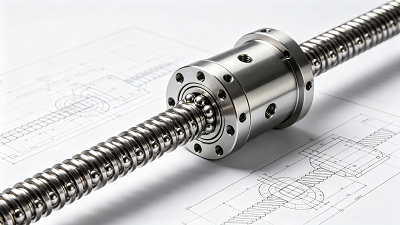
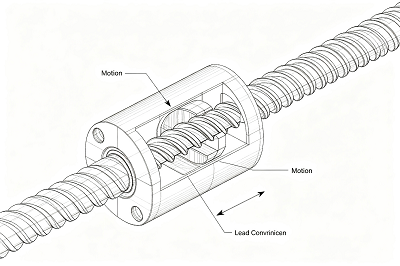
The working principle of a lead screw mechanism is based on the fundamental mechanical characteristics of helical transmission. When the lead screw rotates under driving torque, the helical tooth surface on the screw shaft forms continuous inclined surface contact with the internal threads of the nut. This contact causes the rotary motion of the screw to push the nut along the screw axis under the normal component force of the thread inclined plane.
Specifically, for each complete rotation of the lead screw, the nut travels axially by a distance equal to the lead. During this process, the geometry of the thread profile directly affects the mechanical transmission efficiency. A smaller inclined plane angle provides greater mechanical advantage but slower motion speed; conversely, a larger inclined plane angle enables faster speed but requires greater driving force.
Notably, lead screws operate on sliding friction contact between the screw and nut. While this contact method simplifies construction, it also introduces friction losses, heat generation, and wear issues. The friction coefficient directly impacts transmission efficiency, with typical lead screws achieving mechanical efficiency between 30% and 50%.
Lead vs Pitch: Core Parameter Analysis
Among lead screw technical parameters, Lead and Pitch are the two most frequently confused core concepts. Accurate understanding of their distinction is critical for proper lead screw selection.
Pitch refers to the axial distance between corresponding points on adjacent thread profiles. It is a geometric characteristic parameter of individual threads, determining thread density and tooth dimensions, and directly affecting load capacity and manufacturing difficulty.
Lead refers to the linear distance the nut travels axially during one complete screw rotation. It is the key parameter determining motion characteristics and directly establishes the linear velocity of the mechanism.
Relationship:
- For Single-start threads: Lead = Pitch
- For Multi-start threads: Lead = Pitch × Number of starts
Selection Examples:
- Single-start, 2mm pitch → 2mm lead, advances 2mm per revolution
- Double-start, 2mm pitch → 4mm lead, advances 4mm per revolution
- Triple-start, 2mm pitch → 6mm lead, advances 6mm per revolution
Multi-start thread designs can significantly increase linear motion speed without increasing pitch or compromising thread strength, making them a common solution for high-speed applications.
Lead Screw Thread Types & Selection
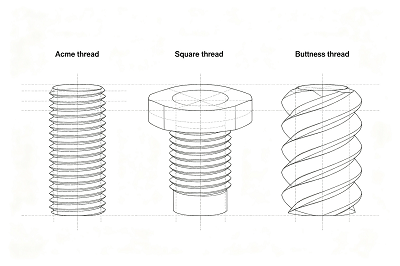
Lead screw performance characteristics are largely determined by thread profile design. Three standard thread types dominate industrial applications:
4.1 Acme Thread
Acme threads represent the most widely used lead screw thread type, with a typical 29° (American) or 30° (metric) thread angle.
- Advantages: Mature manufacturing, lower cost, excellent self-locking capability, high tooth strength, wear resistance
- Applications: General machinery, lifting mechanisms, manual adjustment devices
- Technical Features: Transmission efficiency approximately 30%-40%, optimizable through lubrication
4.2 Square Thread
Square threads offer theoretically the highest transmission efficiency with flank surfaces perpendicular to the axis.
- Advantages: Highest efficiency (40%-50%), minimal radial force component, low friction loss
- Disadvantages: Difficult manufacturing, high cost, weak root strength, poor self-locking
- Applications: Heavy lifting equipment, high-load transmission systems
4.3 Buttress Thread
Buttress threads are designed specifically for unidirectional heavy loading, with one perpendicular and one inclined face.
- Advantages: Exceptional load capacity, high root strength, balanced efficiency and strength
- Disadvantages: Only suitable for unidirectional loading, poor reverse transmission performance
- Applications: Jacks, injection molding clamping mechanisms, heavy presses
Selection Recommendation: Acme threads are preferred for most industrial automation applications, balancing performance and cost.
Lead Screw Assembly Components
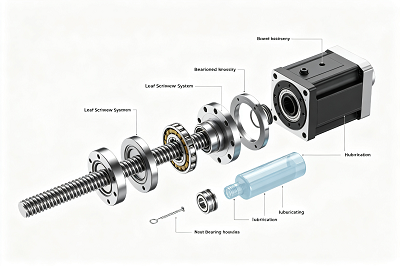
A complete lead screw transmission system consists of the following core components, with design and material selection directly impacting overall system performance.
5.1 Lead Screw Shaft
The screw shaft is the core transmission element, typically manufactured from high-quality carbon or stainless steel through rolling or cutting processes.
- Material Selection: 45# steel, 40Cr quenched & tempered steel, 304/316 stainless steel
- Manufacturing: Rolling (high strength, low cost), Grinding (high precision, high cost)
- Surface Treatment: Black oxide, zinc plating, nickel plating, chrome plating, anodizing
5.2 Nut
The nut is the critical actuator converting rotary to linear motion.
- Standard Nut: Simple construction, low cost, inherent clearance
- Anti-backlash Nut: Eliminates thread clearance through spring preload, improves positioning accuracy
- Material Selection: Tin bronze (wear resistant), brass (machinable), PTFE/PEEK (self-lubricating), engineering plastics
5.3 Support Bearings
Bearing systems provide rotational support and handle radial and axial loads.
- Fixed End: Typically angular contact ball bearings or tapered roller bearings, handling bidirectional axial loads
- Support End: Deep groove ball bearings, allowing thermal expansion displacement
-
Preloading Methods:
- Position Preload: Adjusted via shims, high rigidity, suitable for heavy loads
- Constant Pressure Preload: Applied via springs, automatic wear compensation, suitable for high speed
5.4 Housing & Bearing Blocks
Provides structural support and positioning reference, ensuring installation accuracy and coaxiality.
5.5 Lubrication System
- Grease: Lithium-based, silicone-based, high-temperature specialty greases
- Oil: Circulation systems, mist lubrication
- Solid Lubrication: MoS? coatings, PTFE coatings
Technical Advantages
The enduring popularity of lead screw mechanisms in industry stems from their unique technical advantages:
6.1 Self-Locking Capability
The most prominent advantage of lead screws is their inherent self-locking characteristic. When the thread helix angle is less than the equivalent friction angle, the mechanism cannot be back-driven, maintaining position even when power is removed. This feature is critical in vertical lifting applications, preventing load falls without additional braking devices.
6.2 Smooth Motion
The continuous meshing characteristic of helical transmission ensures exceptionally smooth motion without shock or vibration, making it ideal for precision positioning and low-speed feed applications.
6.3 Simple & Reliable Construction
Compared to other linear transmission solutions, lead screw mechanisms have the fewest parts, most compact structure, minimal failure points, and low maintenance requirements.
6.4 Quiet Operation
Sliding friction contact eliminates rolling element impact noise, operating significantly quieter than ball screws and rack-and-pinion systems.
6.5 Cost-Effectiveness
Under equivalent load conditions, lead screws cost only 1/3 to 1/5 of ball screws, representing the most economical choice for medium-speed, medium-precision applications.
6.6 Environmental Robustness
Lead screws are insensitive to dust, debris, humidity, and other environmental factors, operating reliably in harsh industrial environments.
Technical Advantages
The enduring popularity of lead screw mechanisms in industry stems from their unique technical advantages:
6.1 Self-Locking Capability
The most prominent advantage of lead screws is their inherent self-locking characteristic. When the thread helix angle is less than the equivalent friction angle, the mechanism cannot be back-driven, maintaining position even when power is removed. This feature is critical in vertical lifting applications, preventing load falls without additional braking devices.
6.2 Smooth Motion
The continuous meshing characteristic of helical transmission ensures exceptionally smooth motion without shock or vibration, making it ideal for precision positioning and low-speed feed applications.
6.3 Simple & Reliable Construction
Compared to other linear transmission solutions, lead screw mechanisms have the fewest parts, most compact structure, minimal failure points, and low maintenance requirements.
6.4 Quiet Operation
Sliding friction contact eliminates rolling element impact noise, operating significantly quieter than ball screws and rack-and-pinion systems.
6.5 Cost-Effectiveness
Under equivalent load conditions, lead screws cost only 1/3 to 1/5 of ball screws, representing the most economical choice for medium-speed, medium-precision applications.
6.6 Environmental Robustness
Lead screws are insensitive to dust, debris, humidity, and other environmental factors, operating reliably in harsh industrial environments.
Technical Limitations & Challenges
Despite their significant advantages, lead screws have inherent technical limitations that require careful consideration during selection:
7.1 Friction & Wear
The sliding friction operating principle guarantees wear issues. As operating time increases, thread profiles gradually wear, leading to increased clearance, reduced accuracy, and increased noise.
7.2 Low Transmission Efficiency
Standard lead screws achieve only 30%-50% mechanical efficiency, meaning over half the input power converts to heat loss. This not only increases energy consumption but also limits continuous operation time.
7.3 Speed Limitations
Constrained by frictional heating and PV (pressure-velocity product) limits, lead screw linear velocity typically does not exceed 0.5m/s, with rotational speeds under 3000rpm, making them unsuitable for high-speed applications.
7.4 Positioning Accuracy Degradation
Wear-induced backlash causes cumulative positioning errors, requiring periodic compensation or anti-backlash nut replacement in precision applications.
7.5 Thermal Deformation
Friction-generated heat causes thermal elongation of the screw shaft, affecting positioning accuracy. High-precision applications require temperature compensation or cooling measures.
Alternative Technology Comparison
Different linear transmission technologies offer distinct advantages and disadvantages. Select the most appropriate solution based on application requirements:
|
Technology
|
Efficiency
|
Max Speed
|
Accuracy
|
Self-Locking
|
Cost Level
|
Typical Applications
|
|
Lead Screw
|
30-50%
|
≤0.5m/s
|
Medium
|
? Yes
|
Low
|
Lifting tables, manual adjustment, medium-speed equipment
|
|
Ball Screw
|
85-95%
|
≤2m/s
|
High
|
? No
|
High
|
CNC machines, robotics, high-speed automation
|
|
Linear Motor
|
90-95%
|
≤5m/s
|
Ultra-High
|
? No
|
Very High
|
Ultra-high speed precision, semiconductor
|
|
Rack & Pinion
|
90-95%
|
≤3m/s
|
Medium
|
? No
|
Medium
|
Long stroke, heavy load gantry systems
|
|
Timing Belt
|
90-95%
|
≤10m/s
|
Low
|
? No
|
Low
|
Light load high-speed transfer
|
|
Pneumatic/Hydraulic
|
-
|
Variable
|
Low
|
? Pressure hold
|
Medium
|
Simple reciprocation, high force
|
Typical Industrial Applications
Lead screw mechanisms find extensive application in the following fields due to their unique advantages:
9.1 CNC Machine Tools & Processing Equipment
- Feed axes for CNC mills and lathes (medium/low speed models)
- Electrode feed for EDM machines
- Precision feed mechanisms for grinding machines
9.2 Additive Manufacturing & 3D Printing
- XYZ axis positioning for FDM 3D printers
- Z-axis lifting for SLA printers
- Precise material feeding control for extrusion mechanisms
9.3 Medical Devices & Life Sciences
- Precision positioning for surgical robots
- Accurate dosage delivery for medical syringes
- Sample handling in laboratory automation
- Scanning mechanisms for diagnostic equipment